Wednesday, June 4, 2014

Albania 3: Saranda, Butrint and Albanian Riviera


Leaving Gjirokastra, we head toward the coast. We stop at the “blue eye,” a source of a small river around which a pleasant park has developed. It is not Blue Hole in Belize, but with the center 40 meters deep, the colors range from turquoise to deep blue and the gushing water is cold, clear and refreshing. Saranda is a short distance from here, and we first drive up the hill overlooking the city to have lunch in celebration of our driver’s birthday. It is the Ionian Sea that greets us and Corfu, a Greek island, comes into view. In fact, Saranda is a gateway to Albania for those who take the ferry from Corfu, and this is partially responsible for an apparent rapid build-up of the city in recent years. Nonetheless, Saranda’s oceanside promenade is pleasant and is filled with locals and tourists enjoying an evening stroll.
Blue Eye: I wasn't going to go near the water after the mishap in Benja Canyon which ruined my camera.

 
Saranda on Ionian Sea

Saranda: stopping at a castle on a hill for lunch
 
Saranda: we have taken a liking to grilled vegetables here and order them at every opportunity.
 
 
Saranda: Ionian Sea with Corfu, Greece in view


Saranda: a view from our hotel room. Corfu seen again.

 
Saranda: promenade in the evening
 
A half hour’s drive further south is the remarkable archeological site of Butrint. Occupying a small peninsula along the complex-shaped Ionian coastline, it has seen numerous civilizations come and go with the dominant architecture from Hellenistic, Roman, Medieval and Venetian eras. Entering the park, we are soon on a woodsy trail through the ruins, which is somewhat reminiscent of Mayan sites that are covered with jungles. We hurry to the museum before it closes which is located on the end of the trail. In the museum courtyard, there is a physical archeology class going on. What a great location for outdoor studying. Uttica College in New York has been running a few-week college course at this location every summer and the professor offers to take us to an excavation site the following day. But alas, we are traveling nomads and have to move on.

Butrint: walking along the ruins


Butrint: The Greek inscription seen on stones here announcing freeing of slaves in honor of Asclepius, 4th century BC. The theater is seen behind (right).


Butrint: The 6th Century Baptistry has mosaic work covering the floor, which has been covered with soil for protection. Imagine the eight concentric circles of mosaics along with columns. Conservation is of course critical but this practice makes you wonder "if a tree falls in a forest..."


Butrint: these walls along the inlets of Ionian Sea are a testament to history.

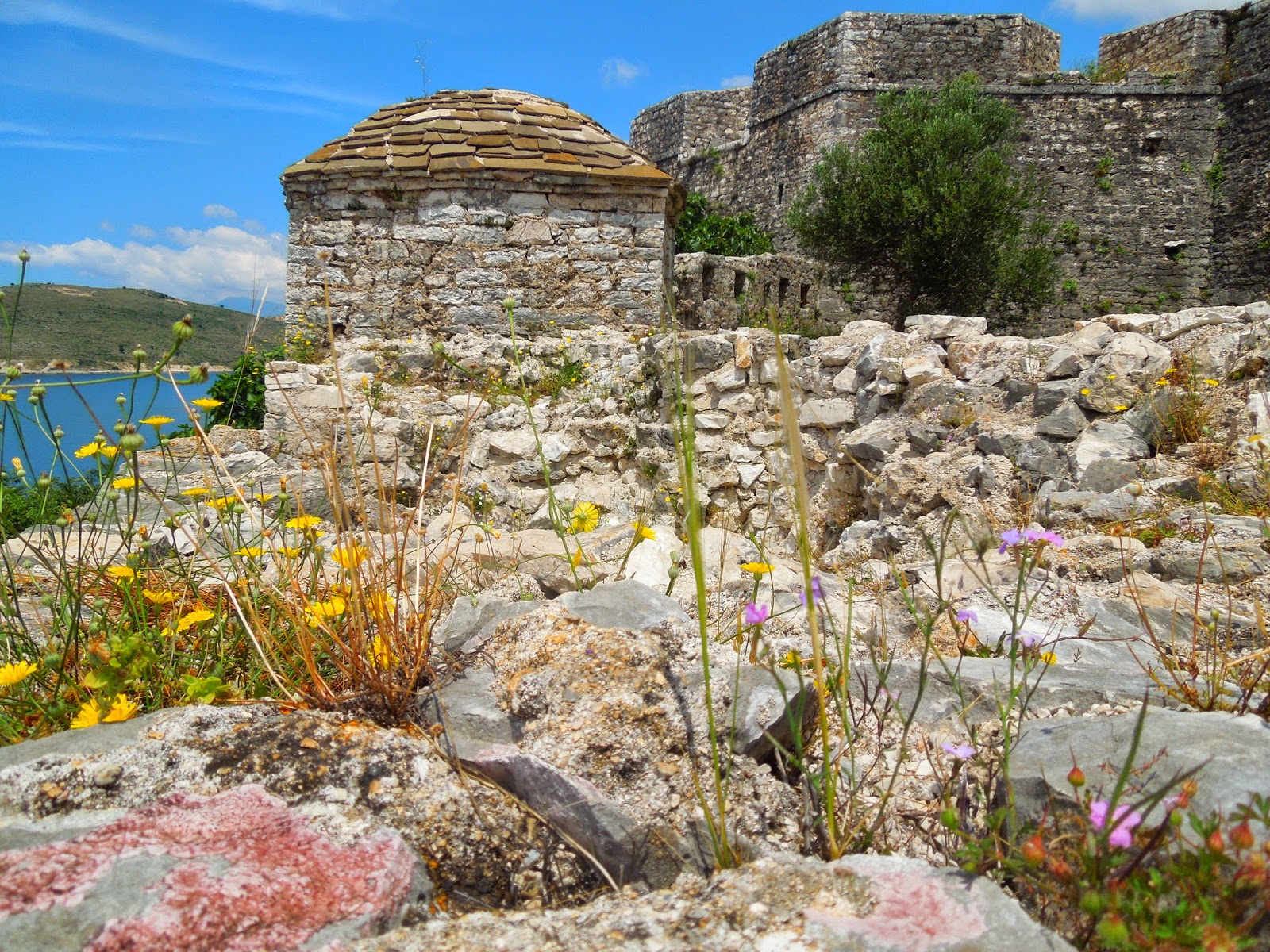
Butrint: A luxury car ferry... one of Ali Pasha's castles in view.

 We are now heading up north along the section of the Ionian coast, called Albanian Riviera. At Porto Palermo, we stop at one of the castles built by Ali Pasha, an important ruler in the entire southern Albanian region under the Ottomans during the late 18th and early 19th century. Next stop is the Llogara National Park, where we drive up and up the winding road to reach the top. After lunch we go downhill to our next destination, Vlora.

Porto Palermo: these bunkers, widespread throughout the country, were constructed to be used as propaganda against imaginary American attacks on Albania during the Communist era

Porto Palermo: Ali Pasha Castle coming into view

Porto Palermo: Ali Pasha Castle

Porto Palermo: Ali Pasha Castle on Ionian Sea

Porto Palermo
 
Llogara National Park: Goat, turn around, Dhermi Beach is on the other side!

Llogara National Park: near the summit

Llogara National Park: buying some honey and propolis

Llogara National Park: a nice lunch spot


Monday, June 2, 2014

Albania 2: Gjirokastra

Not having my main camera is somewhat liberating. With my point and shoot back-up, I am not spending much mental energy on the settings or creativity, as I just point... and shoot.

Gjirokastra feels special. The entire town appears perched on a hill being overlooked by a 13th century citadel on top. A collection of well-preserved Ottoman-era houses with unique architecture has given the city the UNESCO World Heritage status. The citadel is a good place to roam around. The narrow steep streets are fun to walk around. Gjirokastra gave birth to the notorious dictator Enver Hoxha, but also to the revered writer, Ismail Kadare.


Gjirokastra: set on a hill
 
Gjirokastra: A cluster of traditional houses

Gjirokastra: traditional houses
 
Gjirokastra: the Citadel, a good place to wander around.
 
Gjirokastra Citadel: great views of the city and the valley


Gjirokastra Citadel: this American plane was captured and used for propaganda during the Communist era


Gjirokastra Citadel: view of the city
  

Gjirokastra: a typical street where we bought an antique cow bell.


Gjirokastra: one-man show - he takes an order, grills lamb and eel, and serves.

 
Gjirokastra: the local writer Kadare has been nominated for Nobel Prize in literature.
 
 
Gjirokastra: young and old, people enjoy watching the world go by from the numerous balconies in town
 
 
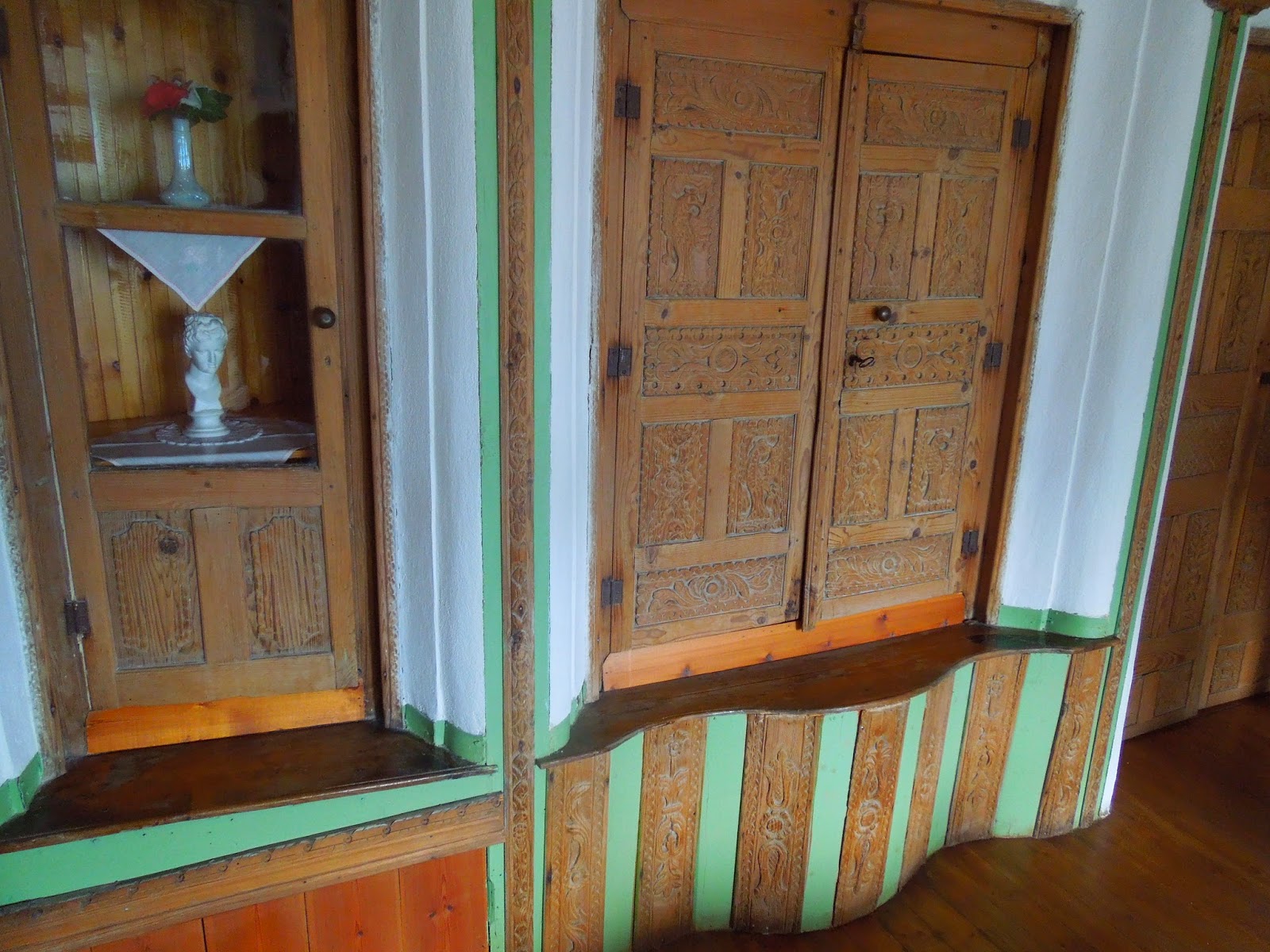
We have a chance to visit three traditional houses in town. First, our hotel itself is a well-restored structure featuring original architecture, fine woodwork and interesting furnishings. Down the street is the house where Enver Hoxha was born, which has been turned into Ethnographic Museum. As a museum, the collection is pretty modest, but its historical significance and again the unique architecture make it worth a visit. We are the only guests there to enjoy listening to the museum staff. And lastly, again we are the only guests visiting one of the private grand houses, Skenduli House, which has recently been partially restored.


Gjirokastra: A stupendous view from our hotel balcony


Gjirokastra: second floor common area in our hotel, Kalemi Hotel, a tradional house

Gjirokastra: original woodwork in our hotel

Gjirokastra: original woodwork in our hotel


Gjirokastra: a hotel worker joins in a spontaneous yoga session. There is sometimes blurring of lines between personal vs professional here, which often represents a delightful welcome to travelers, but those who always want a strict personal space may find it a bit uncomfortable


Gjirokastra: this is supposedly the room where Enver Hoxha was born. His mother's dowry is the chest on the right.


Gjirokastra: a 200 year old bridal chair in Ethnographic Museum
 
Gjirokastra: Skenduli House, one of the grand traditional houses

Gjirokastra: Skenduli House. The owner shows up to give us a tour.


Gjirokastra: Skenduli House. The owner was kicked out with his two-year-old son by the Communist government in 1981 after this house was assessed at $24.

Sunday, June 1, 2014

Albania 1: Korca to Permet


The first impressions of a country can depend on the point of entry, and in the case of Albania, it is not the capital Tirana, but Pogradec which lies near the border with Macedonia along Lake Ohrid. On the outskirts of this non-descript town is a former retreat estate of Enver Hoxha, a Communist dictator who ruled for over 40 years until his death in 1985. So our first topic of conversation about Albania happens to be the modern chapter of its long tragic political and social history. Hoxha is largely responsible for the extreme isolation and oppression to the level only surpassed by North Korea. Our guide tells stories of punishment and even execution at the slightest offense against Hoxha and the Communist party. The misery for the Albanians continued a number of years after the collapse of Communism globally, culminating in 1997 when the country was thrown into near anarchy following a financial pyramidal scheme on a national scale, which is difficult to believe and almost comical.


Pogradec: a former retreat of Enver Hoxha is now a sprawling resort.

Korca, where we spend our first night in Albania, is a major city in the southeastern Albania. Our B&B is located right behind a large church, and we find out to our surprise that the majority of residents in this area are Orthodox Christian, a common situation in the south of the country. We were fully expecting a majority muslim country, but our guide, himself an evangelical Christian interestingly, reminds us that during the communist era, Albania was officially declared an atheist nation and many of its current citizens are not deeply religious, although on paper the majority will list their religion as Islam.


Korca: first school in Albania to use the Albanian language, opened in 1887. Just like at the first Romanian school we saw in Brasov, these note pads may be precursors to the tablets? Alien intervention?


Korca: the National Museum of Medieval Art boasts a collection of 7000 icons. This original iconostasis is in the adjoining church, where the priest tells how they survived the Communist era by simply going with the flow, unlike some of the Catholics who resisted and were persecuted.


A short drive away is Voskopoja, which has several historic churches and a monastery. At St. Nicholas Church, we wait for the caretaker to show up with a key, a scene to be repeated at multiple sites. The wife shows us around, although she declares, “the only thing I know about Christianity is the fact that Jesus was born on Christmas and died before Easter!” To my delight, she lets us take a look at the altar, which is rarely shown to the visitors in an Orthodox church.

Voskopoja: Exterior mural at St. Nicholas Church by Zografi brothers from 18th century


Voskopja: A rare glimpse at the altar, usually hidden behind the iconostasis, at St. Nicholas Church

A drive to Permet, where we next stay overnight, takes longer than the distance would indicate because of bad roads. Passing through Erseka and Leskoviku, towns located just a few km from the Greek border, we arrive at our destination. Permet is an attractive town located along Vjosa River. The lovely setting belies the brutal history as the town was burned down no less than four times during WWII.


Another reason the drive takes longer than you think

I
Erseka: a friendly shopkeeper at a bakery. There are a bunch of young men hanging out in cafes here during the day, reflecting a high unemployment rate, which, according to a couple of young female Canadian missionaries we met who work for World Vision, is a whopping 70%.

Leskoviku: These twins are among a group of children curious about us.


Approaching Permet: Same spot as the cover of our Bradt guidebook


Permet: the hotel owner goes over local attractions. We end up spending an hour with her and her husband, gracious hosts.


Permet: from our hotel room window


Near Permet


We drive a short distance to a nearby canyon at Benja, where an old bridge greets us, which reminds us of the Old Bridge in Mostar, Bosnia. This is the beginning of a canyon, which we start to explore. I hike with the guide for an hour along the canyon walls, over thermal springs and through patches of wild flowers, sometimes scrambling a bit.


Near Permet: Canyon in Benja

Benja: hiking further in, we find another hidden thermal spring


Benja Canyon: going deeper in

Benja Caynon

Returning to the bridge

 We return exhilarated, and as we almost reach our starting point, that is when a disaster strikes. I thought I was being extremely careful with my footing as there are no trails, but at the very last crossing of a stream, I slip on a rock and partially fall into the water. Some water splashes onto my camera and my worst fear materializes. My new full-frame camera would not turn on. Thank God, the memory card was not affected so the pictures from the last couple of days are salvaged. After drying and regrouping in general, I realize my only choice is a back-up camera I brought.


First attempt with my point and shoot camera


Approaching Gjirokastra: we find a nice lunch spot near the river, but our driver is unhappy that they ran out of meat and we have to settle for rice and yogurt.