Friday, October 7, 2016

Italy 8: Verona 2. Vicenza


Verona: making my own non-frozen sugarless yogurt parfait for breakfast at this charming boutique hotel, which is a good value compared to Rome-Florence-Venice. The pace has definitely slowed - sleeping in, a leisurely breakfast, and just a half day of sightseeing. 

Vicenza: today we make a pilgrimage of sorts to the former stomping grounds of Andrea Palladio, who is considered one of the most influential individuals in the history of architecture. We walk down the main drag, named, what else, Corso Palladio.

Vicenza: first stop is Teatro Olimpico (Olympic Theater), Palladio's last work which he actually did not live to see completed. The corridor leading to the theater provides information on the first event to be staged here on March 3, 1585 - Sophocles' Oedipus.

Olympic Theater, Vicenza: the first roofed theater in the world is stunning! We have the place to ourselves and I am just soaking it in.

Olympic Theater, Vicenza: the original scene on the stage, supposedly Corso Palladio, is still remarkably preserved.

Olympic Theater, Vicenza: the inscription refers to Palladio, 1584, erected (Erexit, not Brexit!)

Olympic Theater, Vicenza: a few people trickle in. Would be excellent to see a live performance here.

Vicenza: Palazzo Chiericati by Palladio

Vicenza: Basilica Palladiana by Palladio
Piazza dei Signori, Vicenza: the rooftop of Basilica Palladiana is not open so we settle for some snacks with a partial view of the Basilica as well as Loggia (on right), both by Palladio. The market is closing on the square.

Vicenza: a statue of the architect next to Basilica Palladiana


Piazza dei Signori: Basilica Palladiana and Loggia del Capitaniato

Vicenza: Loggia del Capitaniato by Palladio is a strong presence on the square.

Vicenza: a column with St. Mark's winged lion again - this city was part of the Republic of Venice.


Church of Santa Corona, Vicenza: a nice man collecting tickets at the entrance try to explain to me that the marble altar took 27 years to make.

Church of Santa Corona, Vicenza: a reliquary containing a thorn from the Crown of Thorns, which gives the church its name, Holy Crown.

Church of Santa Corona: Adoration of Magi by Veronese.

Church of Santa Corona: Bellini's Baptism of Christ

Church of Santa Corona: beyond the above treasures, people come here for Valmarana Chapel in the lower level designed by Palladio, which has been nicely restored recently

Palazzo da Monte, Vicenza: another Palladio building

Palazzo Leoni Montanari, Vicenza: this museum holds, among other fine works, a collection of Russian icons, supposedly largest outside Russia.

Palazzo Thiene, Vicenza: another Palladio building

Palazzo Barbaran da Porto, Vicenza: this Palladio structure is now a museum bearing his name. The mulberry tree in the courtyard probably signifies the silk trade through which wealth was accumulated in this area.

Palazzo Barbaran/Museo Palladio: this museum has a number of models of Palladio's works. Since we do not have time to go out to the suburbs, we settle for a model of the famous Villa la Rontonda, which heavily influenced Jefferson's Monticello.

Palazzo Thiene Bonin Longare, Vincenza: walking by one last Palladio building, as we leave town. 

Vicenza: Gandhi's bust? Well, incidentally, this is the birthplace of Sonia Gandhi.
Back in Verona, dinner at Casa Perbellini is a delight. The friendly and down-to-earth chef explains the menu himself and checks on us a couple more times during the meal. We take advantage of the simpler and less pricey set menu they offer, interestingly, before 9pm, at which point only the full tasting menu is available. (Dial the American happy hours ahead by three hours!) 

Every course is excellent. With two glasses of wine included in the price, this meal is probably the best value I have encountered at this level. The staff speak good English and the dark jacket, blue jeans and red sneakers they are wearing set the tone - casual yet professional. 


Casa Perbellini, Verona: the profusion of amuse bouche, even for an abridged version of the tasting menu we ordered, is in line with their hospitality. 

Casa Perbellini: excellent branzino tartar in sesame seed wafers with the spoon presented already wetted with a licorice sauce 

Casa Perbellini: spaghetti vongole with the pasta made with Integrale (whole) grain, zucchini and calamari crumbles

Casa Perbellini: an excellent dessert with generous petit fours is an appropriate way to end the superb meal.

Casa Perbellini: a three-way dessert with cotton candy, a pineapple based drink inside a white chocolate casing. This is a great antidote to the shocking meal a couple of nights ago at La Fontanina. My faith in fine dining in Italy is restored.

Thursday, October 6, 2016

Italy 7: Verona.1. Mantova


Verona: just an hour and ten minutes from Venice by train, this is the second largest city in Veneto after Venice. A couple of blocks from our hotel is a Roman arena, simply called... the Arena. Known to opera fans for its summer opera series, it hosts concerts off-season. (Looks like in a couple of days it will be Andrea Bocelli, who I don't consider a real opera singer.) The building seen in the background (right) is the City Hall, Austrian-built with a yellow facade.

The Arena, Verona: ah, these pink marble seats. They are preparing for an upcoming Bocelli concert.

Verona: Piazza delle Erbe seen from inside a gelateria. The winged lion of St. Mark on top of the column is a mark of Venetian influence.

Piazza Erbe, Verona: a Roman-era fountain attracts the attention of a child.

Casa di Giulietta: that would be Juliet's House... as in Romeo and Juliet. Band-Aids and gum seem to be popular media to post love messages with at the entrance.

Juliet's Balcony and statue: this is what people do here. Men and women. (The name of the main square here, Piazza Bra, is purely coincidental!) None of this is real but that has not deterred throngs of curious tourists and lovers on a pilgrimage from admiring the cute balcony.


Verona: a Renaissance staircase at Palazzo della Ragione

Verona: 14th century Gothic tombs of the Scaligeri: Verona's dominant family in history would have their lofty ego hurt if they found out a crane is now higher than their unusual graves.

Verona: the pleasant interior of Church of Sant'Anastasia

Verona: Castello San Pietro is seen across Po River. We are walking up there after crossing Ponte Pietra (in the distance on left).

Verona: sunset from Castello San Pietro

Verona: the sun going down with Duomo Campanile in the foreground

Verona: an evening scene from Castello San Pietro (towers are Church of Sant'Anastasia and Piazza Erbe, right to left)

Verona after sunset: Ponte Pietra over Po River in view

The dinner reservation is at a restaurant conveniently located at the foot of the hill we just climbed to see the sunset. This turns out to be a most unusual dining experience though, and that's putting it mildly.

Walking in, we are greeted, not by a warm welcome (although we seem to be the only diners), but by the funky decor featuring all manners of stuff packed into every available inch of space with no pattern. Spooky. The chairs are very uncomfortable. The daughter's wine glass contains large bits of cork. The red wine I am drinking is about the worst ever. Some dishes are fine but others are extremely salty. The owner does not seem to care about any of this. Why oh why did the French tire company decide to award a star to this strange place??

Osteria la Fontanina, Verona: pretty close to a dinner from hell. This dish, "green ravioli," (the colors are from parsley and basil) is actually half decent, but one piece contains an olive pit! Other offenses are listed above. The decor is like in a New Orleans voodoo house.

Verona: Arena at night

Mantua (Mantova): a day trip to this city lying less than an hour south of Verona. Mantova is all about the Gongaza family which ruled the city from 14th to 18th century. We are visiting Ducale Palace (right).

Mantova: before the main museum at Ducale Palace, we head to a separate part of the complex which houses Camera degli Sposi (Bridal Chamber) which opened again last year after an earthquake damage in 2012.


Bridal Chamber, Ducale Palace, Mantova: this room is known for its frescoes by Andreas Mantegna, an early Renaissance master who worked extensively for the Gonzaga family.

Bridal Chamber, Ducale Palace: the Mantegna creation here is known for technical innovations, especially the trompe-l'oeil method applied to the ceiling called di sotto in su

Ducale Palace: now at the main museum, we start with apartments of Isabella d'Este, an important woman of Renaissance. She is also a candidate for the subject in Mona Lisa, although the portrait (a copy of Titian's work) on right does not bear too much resemblance to the famous Da Vinci painting.

Ducale Palace: look, the initials of Isabella, reputed to be erudite and politically astute, are the same as mine! 

Ducale Palace: Pisanello's partially preserved and newly re-discovered frescoes with a model of the original in front

Ducale Palace: a remarkable painting by Peter Paul Rubens, Gonzaga Family worshipping the Holy Trinity, has an intriguing history. The painting was cut up by the Napoleon army and then sold, and recently some of the pieces have been recovered and re-united here.


Ducale Palace, Mantova: Corridor of the Moors


Mantova: a Rigoletto statue (La donna e mobile!!). Although he is a fictional figure, the Verdi opera is based on Mantova and the city decided to market one of the old buildings near Ducale Palace, which the court staff would have frequented, as Casa di Rigoletto. The house is now a Tourist Information Center. 
Monteverdi's important opera, L'Orfeo, was composed in Mantova for the Gonzagas.

Church of Sant'Anastasia, Mantova: this octagon supposedly contains the holy blood of Jesus, brought up from the crypt and paraded once a year on Good Friday.

Mantova: before taking a train back to Verona, a slight detour to this popular gelataria, Papa Reale. I have developed a liking to stracciatella which has chocolate bits. Repeated lines of stressed/desserts share the board, although they are obviously not the first one to discover the palindrome.

Ristorante Torcolo: back in Verona, it's time for a simple dinner, so we take a few steps across the little street from our hotel and walk into this typical Italian trattoria. It is early and the staff, mostly family members, are still finishing their own dinner (left) while greeting us with cheerful "Buona Serra." The friendly patriarch, a John Goodman look-alike, is the last to get up, put on his apron and start serving tables.

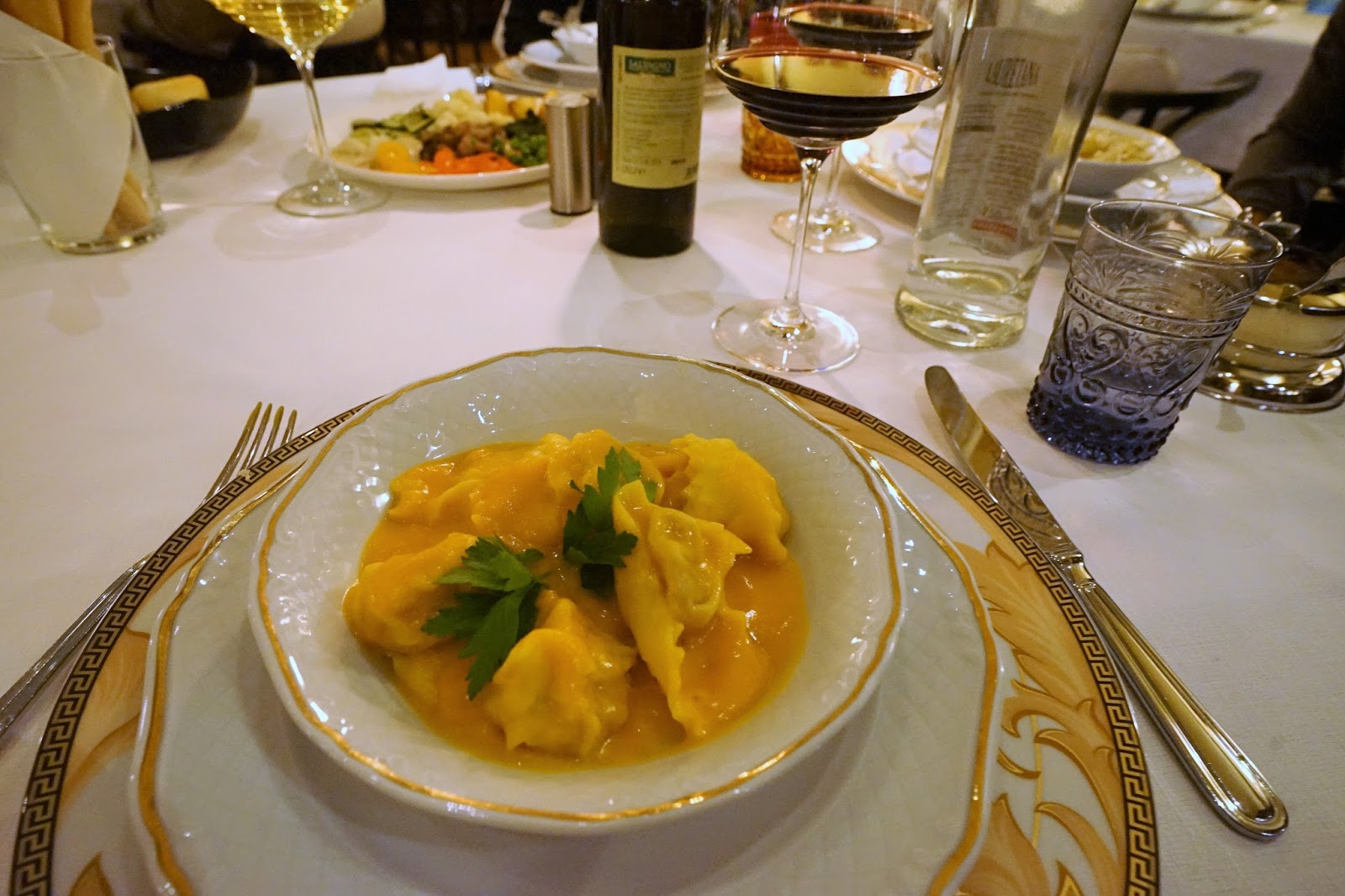
Torcolo: compared to last night's disaster dinner at La Fontanina, this is a straightforward satisfying (i.e., normal!) meal for half the price. Many items are under 12 euros and of acceptable quality. This tortelli di zucca, bathed in a thick sweet pumpkin sauce, although not as fancy as tortellini di zucca I had at Dal Pescatore last year, is eminently acceptable. The same combo appetizer of poached eggs, creamy cheese and black truffle that I had last night's weird dinner, is at least as good here and lower priced. Finally a decent meal in Verona.