Sunday, September 4, 2016

Hong Kong 2. Macau

Back in Hong Kong, there is one thing we are focusing on for now - Tim Ho Wan. Can't leave Hong Kong after only one dim sum meal, even on a short visit, can we? As our flight arrives in the afternoon, choices are limited. Might as well try what was known as, until the Singapore hawker stalls received their stars in July, the cheapest restaurant to receive a Michelin star. Actually, of the five Tim Ho Wan outlets in Hong Kong, the prestige currently applies to only two, whatever the tire company's reasoning is, including the Sham Shui Po branch on the Kowloon side, which is our target. 
We are on a mission to get there during what I presume to be a sweet spot between lunch and dinner. We take a taxi instead of the MTR, realizing that the taxi ride may cost almost as much as the meal there. Efficiently moving from the airport to the hotel to the restaurant, we arrive at Tim Ho Wan at 3:45pm, well within our target. To our surprise, the place is half empty! The atmosphere is also unexpectedly relaxed and the staff pretty helpful.

We pig out (as well as shrimping out) on no less than 10 dishes, including baked pork buns which is a must. I would rate at least several of these as the best I have ever had, including the slightly salty har gow, the siu mai with a generous shrimp portion, and the steamed dumpling in chiu chow style (fun gor) with a most delicate skin. The total bill comes to about US $25 for 10 dishes. Unreal. I am concluding that there is no reason to try dim sum at any of the more expensive places unless you need unusual or fancy creations, prvided you get a table without much aggravation.

Tim Ho Wan: a successful quest! Like everyone, we order their legendary baked pork buns, which some may say are too sweet, but they are just right for me! This item deserves the hype as well as a number of other things we try.

Mido Tea House in Yau Ma Tei: we have some time to kill before Temple Street Night Market gets going, so check out this supposedly vintage tea house (Cha Chaan Tang) with a retro look from 1950's overlooking Temple Street. But I am not overly impressed with the interior. Milk tea there is pretty good with the other drink being "boiled coke with lemon and ginger," as crazy as it sounds.

Temple Street: stepping right outside Mido Cafe, we find a number of stalls. However, there aren't enough vendors to fill the street. I had even scouted out a vantage point atop a nearby garage but won't need to go up to take a picture. Weak!

Temple Street: disappointed, I try a bit of street photography, and there are enough interesting scenes around.

Giving up on Temple Street Night Market has its advantage. We make it down to the harbor front in time for the "Symphony of Lights" starting at 8pm. Avenue of Stars, the usual viewing site, is under construction, so it is quite confusing where one needs to go, but we do find a platform nearby.

Symphony of Lights: where is the symphony and where are the additional lights? Where is the beef? We do see a few dancing laser beams from a couple of buildings, but I don't blame the American behind me who genuinely wonders out loud, "is there some sort of equipment mal-functioning?" Pretty weak! Well, the night view is nonetheless worth watching for 15 minutes.

Garden of Stars: the iconic statues originally on display on Avenue of Stars have been relocated here, including that of Bruce's which stands next to Anita Mui's.

We take the ferry to Macau, just like James Bond did in the Man with the Golden Gun (actually he did the reverse route). The speedy catamaran take only an hour but rides waves en route making some of the passengers a bit queasy. (Fortunately I have never known seasickness.) Upon arrival, many tourists ride buses provided for free by the casinos. We head to Grand Lisboa Hotel for lunch.


Robuchon au Dome, Macau (excuse the lack of French accent marks): the dome marks the highest point of Grand Lisboa with the eye-catching architecture.

Robuchon au Dome: a massive bread cart signifying a place that seems to thrive on excess

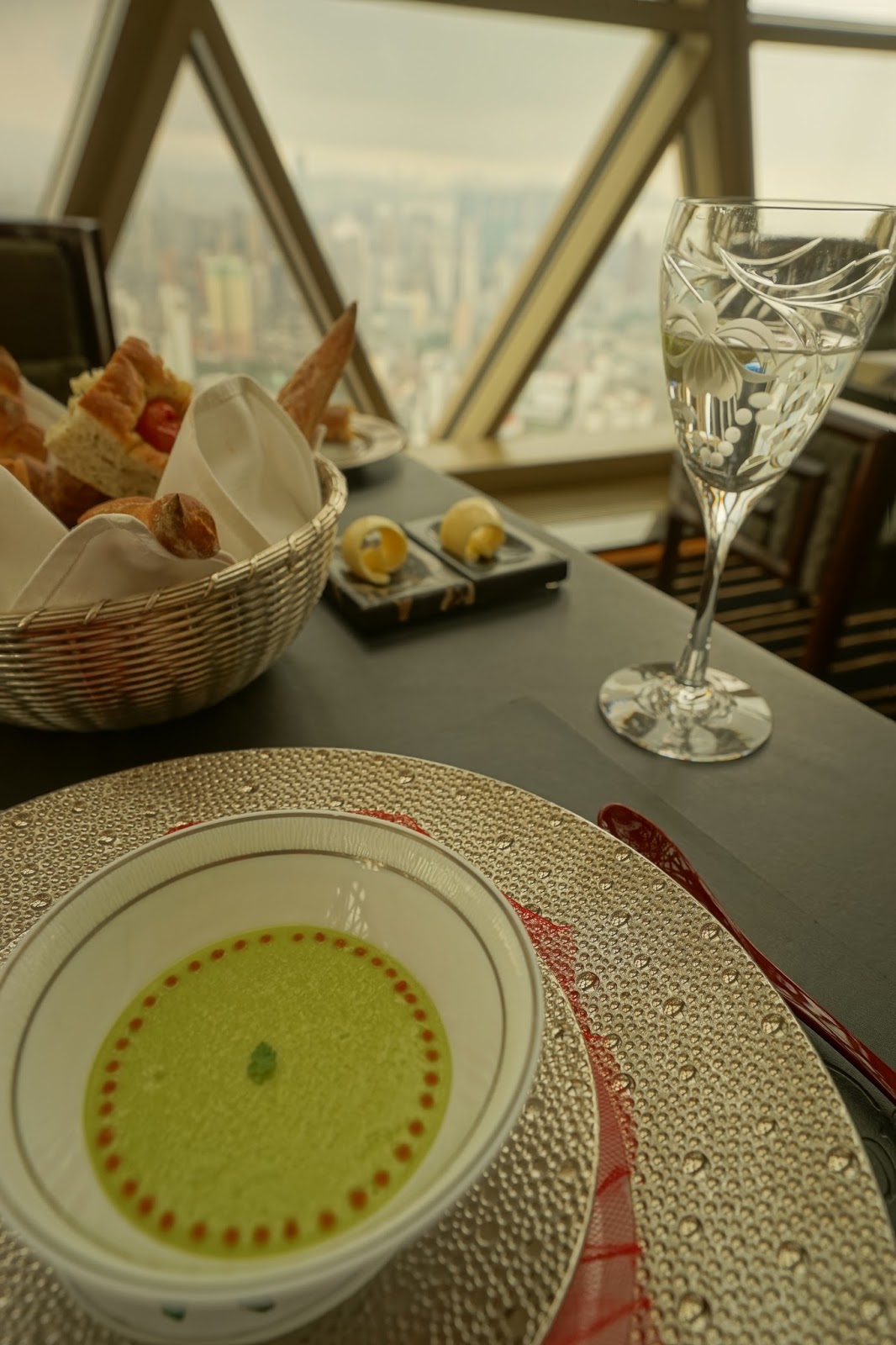
Robuchon au Dome: most tables are next to windows around the dome, affording a view of Macau

Robuchon au Dome: opulence in both surrounding and food. You wonder how Monsieur Robuchon manages quality at so many restaurants in his empire over the world. 
Oh, look what I found through the dome window - the ruins of St Paul's, the #1 historic monument in Macao! It's right in front of me - maybe we won't need to go there today!
Robuchon au Dome: an over-the-top petit fours cart.

Macau: casino hopping is one way to spend time in "Las Vegas of the East." (if Macau actually has higher gambling revenue than Las Vegas, then perhaps Vegas should be called Macau of the West?) Venetian on the right and the City of Dreams complex on the left. Inside Venetian, supposedly the largest casino in the world, there is a whole lot of selfie action with the fake Italian art work in the background. 


Coloane: a very modest village in the southern end of Macau on a separate island. A landmark here is Chapel of St Francis Xavier, which contains a painting of Madonna and Child with Chinese faces and clothing. 
Lord Stow's Bakery, Coloane: but the real reason we are in this remote town is the bakery known for its pastel de nata (Portuegese egg tart). The daughter couldn't be happier. The line moves fast, but to get here is difficult as bus drivers speak little English


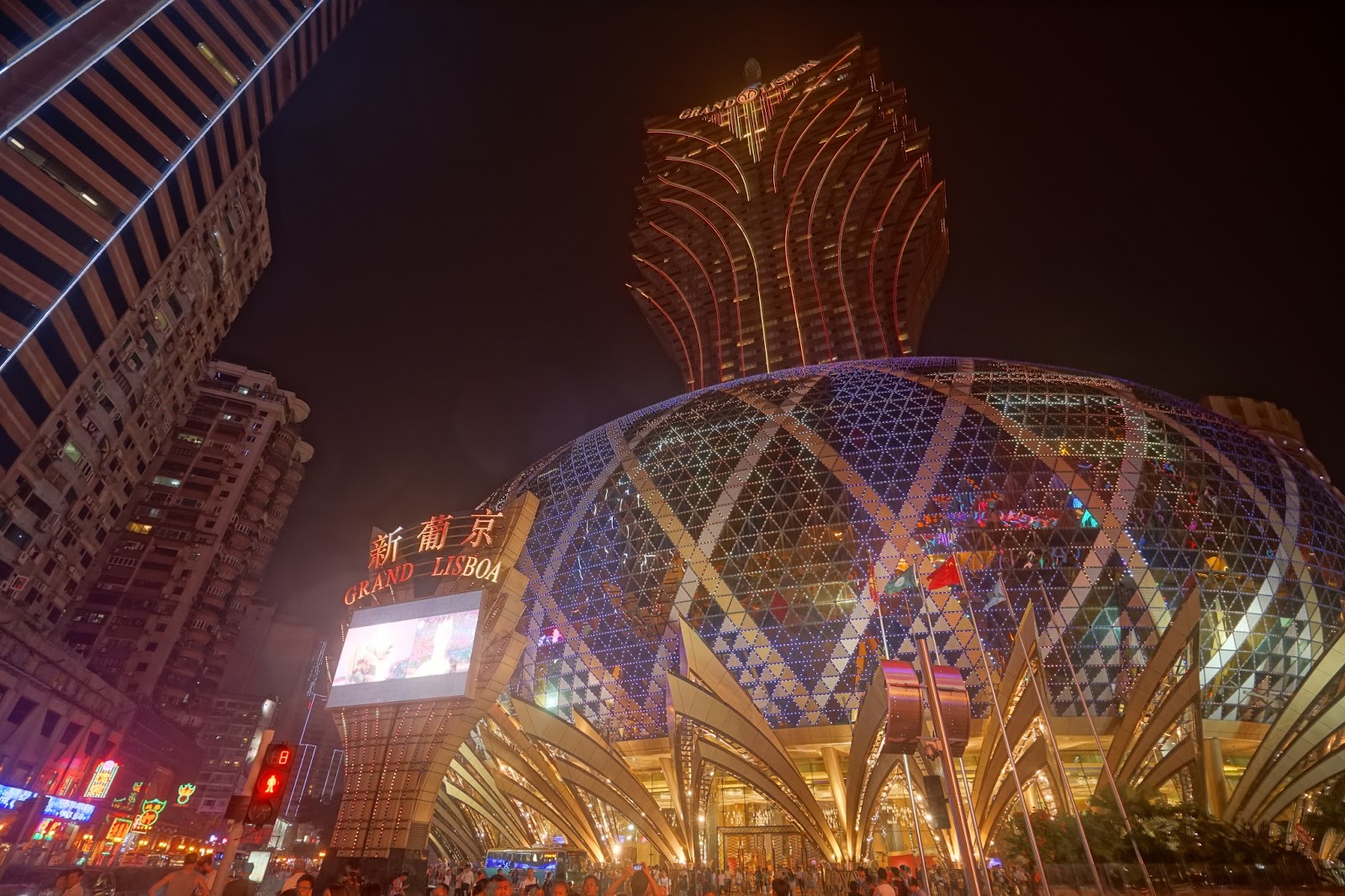
As we head toward Macau Peninsula on a bus, the silhouette of Grand Lisboa Hotel looms large in a haze. We had lunch at the dome there and now we are going back to that hotel for dinner. I cannot help but think that without casinos, this place would be quite dull and economically struggle.

Ruins of St Paul's, Macau: we have time to visit before dinner. 

The maze-like area near the ruins of St Paul's is quite lively on a Saturday night.

Walking back to the casino area, using the lit Grand Lisboa Hotel as our North Star.

As we get out of Wynn after a quick look, I hear the music "O Mio Babbino Caro" and it's the dancing fountains!

Grand Lisboa fully lit: we are heading to the second floor for Eight, as we have a reservation at 7:30 at Eight. What? No typos here - the name of the restaurant is The Eight!

The Eight: there are enough symbols and signs of eight here, the number beloved by Chinese
The Eight: it is one of those places you wonder about - hidden behind the dark-paneled door that blends into the surrounding wall, which represents a barrier to entry. After passing one of those doors, we walk in a short futuristic passageway with holograms, which opens up to a spacious and elegantly appointed restaurant.

The Eight, Macau: they seem to refill the Oolong tea after each sip but charge extra for XO sauce (I need an XY sauce - Extra Young!); 


The Eight: in between seafood and meat courses, a great vegetarian dish of tofu skin and gingko fruits

The Eight: the taro pudding with a chocolate butterfly finishes off what I think is the best Cantonese dinner I have ever had so far, as the day trip to Macau ends.

Back in Hong Kong, forget sightseeing, it's going to be another day of shameless gastronomic pursuit. We are greeted by sophisticated decor and friendly dedicated service at Amber. Excellent amuse bouche including a buckwheat cracker with vegies on top (on a tall stand).

Amber, Hong Kong: "Kohlrabi" - this is a new version of their signature Hokkaido uni dish, which has now been "retired" and is rumored to be replicated at Corey Lee's new restaurant at San Francisco MOMA.

Amber, Hong Kong: very strong in the dessert department - overall an excellent value of a weekend wine lunch (and I usually don't even drink much wine)

Pacific Palace: after lunch, we end up inside one of the large shopping and entertainment complexes. Come to think of it, we did not set foot outside today, starting from the MTR station in Kowloon to the Landmark Mandarin Oriental Hotel to here. We are actually here to see a movie (AMC in upper right).
A L'Eclair de Genie "boutique," tempting but to be resisted after a high calorie lunch.

A movie in the middle of the day on a trip abroad? Yes, 1) to avoid heat, 2) to kill time before dinner, 3) to relax in a typically comfortable Asian movie theater seat, and 4) to check out a popular Korean zombie movie, "Train to Busan."

Lung King Heen: gathering with Dennis and his two friends for dinner at this premier Cantonese restaurant

Lung King Heen: we let Dennis pick the dishes, otherwise would never know to order superb ones like this "scallop and Asian pears."

Lung King Heen: very interesting vegetable dish based on winter melon jelly. We also try, among others, their delicious version of fried rice (not shown), which Dennis points out uses Har Mi sauce we came across at Bo Innovation earlier.

Lung King Heen: but the star of tonight's dinner is this abalone dish (sliced Amidori abalone with goose web and Chinese mushroon), a rare treat obscenely priced. A memorable meal to end this short culinary adventure in Southeast Asia.

Thursday, September 1, 2016

Singapore


A few days before arriving in Singapore, we face the double whammy of bad news that the air quality has deteriorated because of forest fire in the neighboring island of Sumatra and the number of Zika cases is increasing. Now I have to worry about those in addition to not chewing gum in public? (Actually the gum thing is somewhat confusing as the law just applies to not selling gum other than for health reasons, but there is no question the "gum control" has been extremely effective here.) 
Other half-amusing punishable offenses include connecting to another person's wifi, not flushing a public toilet, and "expelling mucus from the nose." Although I don't agree with all the banned items, I am willing to comply if it promotes civic mindedness (as Lee Kwan Yew envisioned), or at least to avoid flogging (actually I am fortunately over the age limit for caning!)

Luckily for us, it had just rained before our arrival and the weather is cooler and air quality better than expected. So we take a short walk from the hotel to Chinatown Complex Market and Food Centre to check out hawker stalls, and one in particular that has achieved instant global recognition when the Michelin star ratings were announced in Singapore for the first time in July.


Hong Kong Soya Sauce Chicken Rice and Noodle: What, no line? Wait, no one around? Turns out the entire complex is closed for cleaning that's scheduled every three months. (Their chicken rice still costs only two Singapore dollars, or about US $1.50, which unquestionably makes this place the cheapest Michelin-starred restaurant in the world.)  So Plan B.

Out of Chinatown Complex toward Maxwell Food Centre a few blocks away, we pass by Buddha Tooth Relic Temple. The name refers Buddha's left fourth canine tooth enshrined here. For sure.

Plan B is in trouble also. The line at Tian Tian Hainanese Chicken Rice is relatively short but the euphoria doesn't last long, as they announce being done for the day. We don't get to try the rice that Anthony Bourdain gushed over. So Plan C: three stalls down is Ah Tai, operated by a former chef at Tian Tian who left after dispute. But alas, it is the day of their normal weekly closure.

Plan D: Go to a random open place selling chicken rice. The dish from Maxwell Hainanese Chicken Rice is definitely good enough to the un-discerning palate and I can see why Hainanese Chicken Rice is considered Singapore's national dish.

Right across the hall, a picture of Bourdain on the window of this stall catches my eye (lower left corner). A page from his book describes him strolling down the hall and being curious about a lady who's been doing this one thing for 35 years. Well, I am equally curious. The crisp oyster pancake is quite good. Our first foray into the hawker food scene in Singapore is declared a success!
It's getting dark so we head to Marina Bay to catch night time light shows. We take MRT, which is not a dyslexic cousin of Hong Kong's MTR, but an efficient enough system in its own right. Inside the subway car, next to the Subway ad for chicken tandoori is a list of forbidden items: no eating or drinking, no smoking, no flammable goods, and... no durians!


Marina Bay Sands: a ginormous structure reminiscent of some of the behemoth resorts in Las Vegas

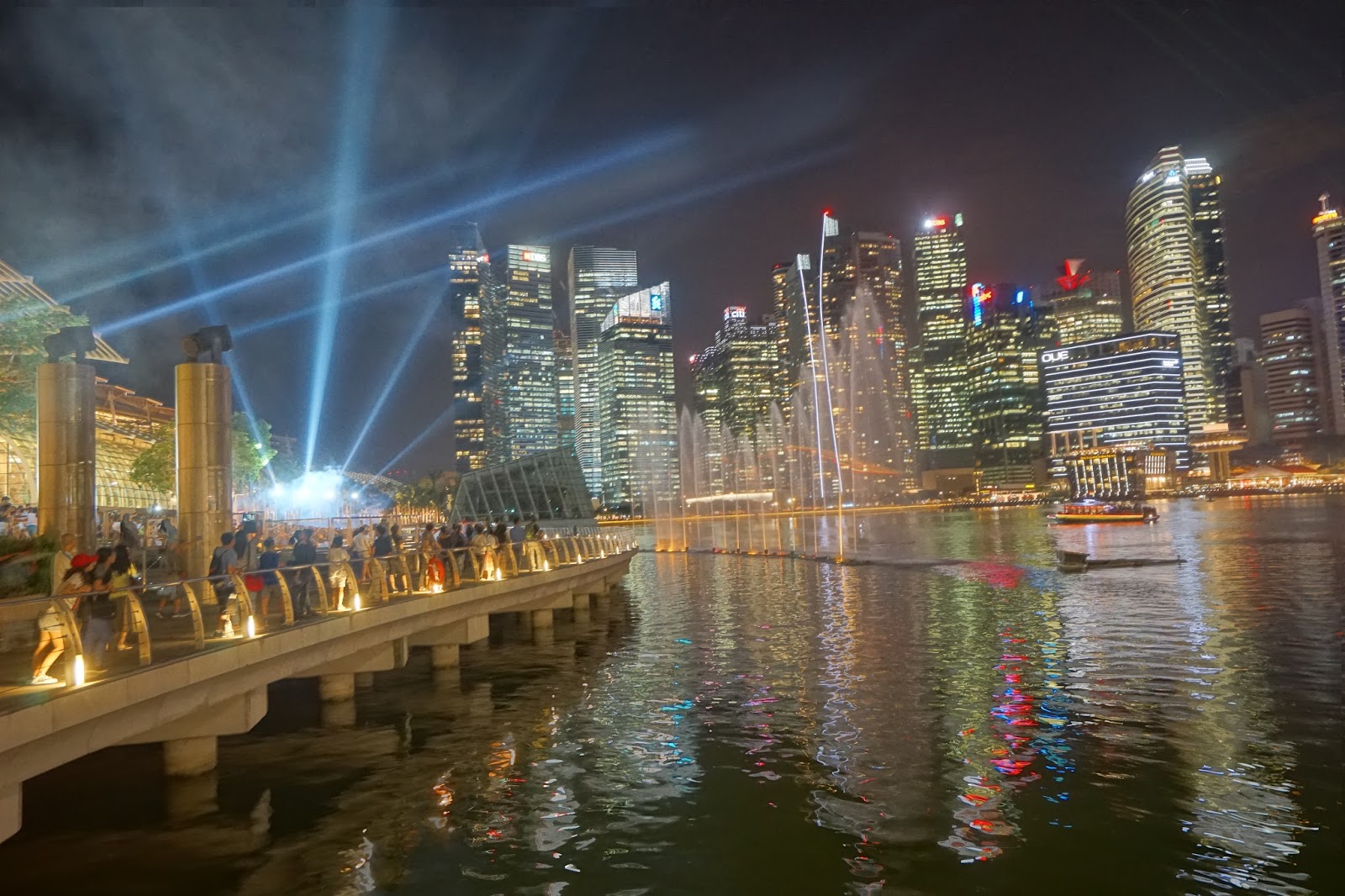
Marina Bay: getting ready for the light show "Wonder Full." We get ready by slapping mosquito-repellent stickers on our clothes, which may or may not work.

Marina Bay: light show

Marina Bay: lights reflecting on Louis Vuitton "Island Maison" and the lotus-leaf shaped ArtScience Museum

Marina Bay: light show
Marina Bay: enthusiastic audience but the crowd size very manageable
Marina Bay: the finale of "Wonder Full" to the tune of, what else, Louis Armstrong's "What a wonderful world."

Marina Bay Sands: this monstrous building grows on you. Traversing it to reach a viewing point for Gardens in the Bay.

Gardens in the Bay: these "Supertrees" are built to perform environmental functions but they serve an aesthetic role as well, especially when coming alive at night.

Gardens in the Bay: the colors change rapidly during the nightly synchronized light and music show "Rhapsody" 
My lunch at Andre, not my dinner with Andre, but as memorable and refreshingly unique as the scenes from the Louis Malle classic. What a fantastic meal! From the moment you enter the colonial style house, the site of the first law firm in Singapore where LKY worked, to the time you finish the tour of the house and get out of the elevator, the multi-lingual staff cater to you professionally while making you very comfortable. The taste, creativity and presentation of the dishes are a testament to the incredible talents of the Taiwanese-born and French-trained chef Andre Chiang. It puts some of the hyped-up places like The French Laundry to shame.

Restaurant Andre: the beautiful amuse bouche is a harbinger of fascinating things to come.

Andre: the server describes this as a couple - a poor woman (butternut squash) and a rich man (foie gras soup).

Andre: looks like just a loaf of bread but inside is salt-baked Bresse chicken.

Andre: the chef chats with us while petit fours are brought out (the one on right looking like a macaroon is his interpretation of the Kaya toast, a Singporean breakfast treat). We are shown his handsome cookbook based on "Octaphilosophy." He says we should return for a full dinner. Who wouldn't want to! 

Raffles Hotel: a Singapore icon from the colonial era. I respect the sign limiting the entrance to hotel guests. Otherwise I might incur the wrath of the Sikh guard!

Long Bar, Raffles Hotel (a separate entrance, mind you): one of those things you do in Singapore because that's what people do - drink Singapore Sling where it was first concocted. Actually the Autumn Sling (behind it) is more tasty and refreshing. Obviously over paying, I throw down the shells from the peanuts (unlimited supply from the bag) to the floor with glee like you are supposed to.

OK, pampering over. We are on our own now. We take MRT and get off at Lavender a couple of stops away. We find our way to the other one of the two hawker stalls to receive a Michelin star in July. Surprisingly, the line isn't too bad,

Hill Street Pork Noodle and Soup: I am no expert on Bak Chor Mee (minced meat noodles, on left), but each ingredient is so well cooked and I can see why this place is so popular.

"Cloud Forest": visiting the two conservatories at Gardens by the Bay at dusk. The three columns of Marina Bay Sands Hotel and Sky Park on top are seen through the glass from this vantage point next to a man-made waterfall lit purple.

Gardens by the Bay: the light show "Rhapsody" is definitely more enjoyable up close.

Gardens by the Bay: Marina Bay Hotel again seen in the background - I am now getting quite impressed with this structure. It has won me over!
Botanical Gardens: an excellent place to stroll among exotic tropical plants and flowers. It does not feel crowded despite its UNESCO Heritage status.
Corner House: a nice table at a corner of the terrace of this colonial building, named not because it is in a corner within Botanical Gardens but after EJH Corner, a man largely credited for "greening" of Singapore. Who would have thought the world's most visited botanical gardens is in this corner of the globe. The Chef calls his cuisine Gastro-Botanica, a mouth-watering designation.
Ce La Vi: this bar atop Marina Bay Sands Hotel, which used to be called Ku De Ta (the revolutionary spirit gave way to a state of resignation?), is fortunately open despite intermittent rain to offer a great view.
Ce La Vi: admiring Sky Park from below which sits on top of the three columns of Marina Bay Sands Hotel, I had to come up here. To our left (not shown) lies the famous infinity pool.
View of Marina Bay from Ce La Vi, as the sky gets darker
Les Amis: dinner at this respected restaurant is nice enough (their signature angel hair pasta dish above), especially the desserts by the well-known pastry chef (the take-home medeleine in an elegant tin box is a nice touch), but I keep thinking that our last meal in Singapore could have been at another hawker stall at a fraction of the cost. Early such dinner also would have allowed us to linger longer at the al fresco bar in Skypark to look down on light shows. I also regret not having enough time to visit the ethnic neighborhoods in this unique city-state where Chinese, Indian and Malay coexist without much political rhetoric.