Sunday, March 1, 2015

South of France II: Provence 2

 
The Luberon region (no, not LeBron) is pretty compact but dotted with numerous hill-top towns, so visiting a number of them at an enjoyable pace would take days, if not weeks. I have set aside... exactly one day. My ambitious initial list would inevitably get gradually smaller, with the potential first stop at Isle-sur-la-Sorgue on a market day becoming a first casualty before we even hit the Provencal road. We first drive to Oppede-le-Vieux, whose main charm is a little bit of life blown into a formerly dead city. The weather's great and the Mistral is nowhere to be found.

Oppede-le-Vieux: A former ghost town returning slowly to life


Oppede-le-Vieux: Main Square, if you can call it that.

From there, it is a short drive to a trio of hilltop towns: Menerbes, Lacoste, and Bonnieux.
Menerbes is where Peter Mayle, the author of the popular novel "A Year in Provence," initially settled after retirement. Since that book helped put this region on the map, of course we have to check it out. Charming houses hang precariously on a ridge and we have to negotiate narrow steep roads. Pretty but we probably wouldn't want to live here.
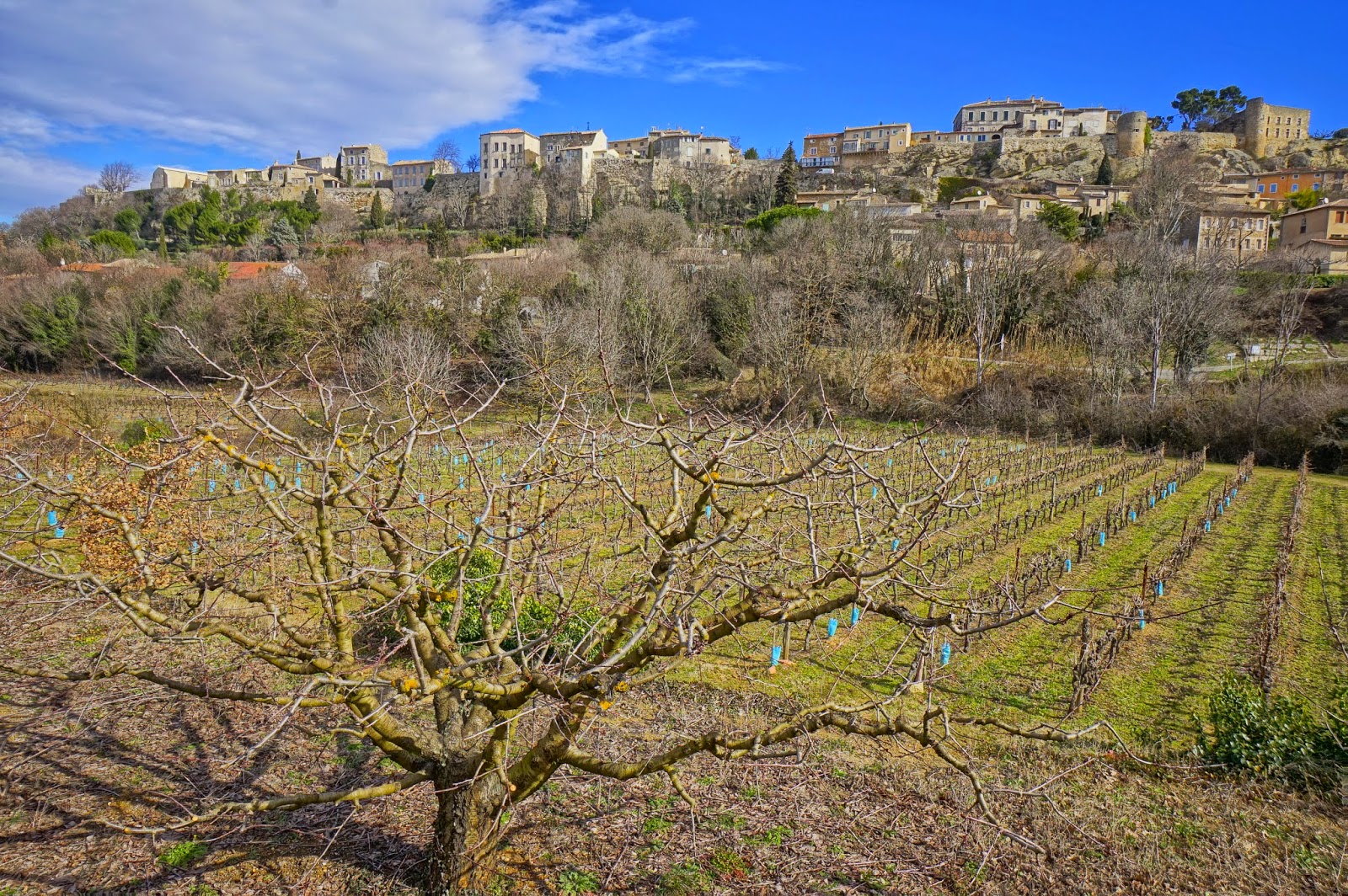
 
Menerbes: where Peter Mayle chose to retire

Menerbes: attractive town with tidy houses
 
Menerbes

The next stop, Lacoste, is identified with the notorious Marquis de Sade. The walk up to the ruins of his castle at the top is not bad, certainly not to the point of being a masochistic behavior. We are way behind schedule and it is already lunch time, but there are no restaurants to be found. One store is open but alas it only sells Lavande. We like the lavender smell but need food! We do run into a few cheerful American art students studying in Lacoste. I guess it is not a bad way to spend your parents' money for 8 weeks, or maybe I am harsh and the students are on their own.

Lacoste: the castle at top is the legacy of Marquis de Sade, now being restored by none other than Pierre Cardin

 
Lacoste: a village seemingly made entirely of stone

Lacoste: steep hills with Mt. Ventoux in the background

Once we reach Bonnieux, there are finally signs of life. We devour pizza with complex toppings - oh, typical French. Bonnieux seems to offer the attraction of a hill town while not losing most of the modern practicalities. I could live here.

 
A typical farmhouse with a vineyard on the way to Bonnieux. Again Mt. Ventoux is visible.

Approaching Bonnieux
 
Bonnieux: Mt. Ventoux seen in the distance on right

Bonnieux

A view of Lacoste from Bonnieux


Looking back at Bonnieux upon heading south
 

At this point, we turn south to reach Lourmarin which most day trippers to the Luberon may skip. Despite being horribly behind schedule, I have to go there, mainly to pay homage to, not Mr. Mayle who apparently resides there after moving from Menerbes, but Albert Camus, who existed in Lourmarin in his later years and is buried there. The town cemetery is just outside the town and thankfully there are directions to his grave.

Entering Lourmarin
 
Lourmarin
 
Lourmarin: tomb of Albert Camus, where we come as strangers
We hurry back north up to Luberon proper with our next destination being the grand daddy or redness of them all, Roussillon. Along the way, we have to forego a couple of stops with regret - Chateau de la Canorgue Winery where the film "A Good Year," featuring the great French actress Marion Cotillard, was shot, and the Julien Bridge, a well-preserved Roman bridge.


Approaching Roussillon: red rocks announce that we are in the ochre country
 By the time we arrive in Roussillon well past 4pm, all hopes of hitting the ochre trail while it's open have been dashed. But the town itself is attractive in an unusual way. The surrounding area is reminiscent of Arizona or Utah on a smaller scale, but as our guidebook stated, it could also be a Santa Fe on a hilltop. It is understandable that this is perhaps the most popular tourist destination in Luberon.

 
Roussillon


Roussillon: situated in the colorful canyon

Roussillon


Roussillon: surrounded by colors


Roussillon

 
Roussillon: streets are red and lined by art galleries
As we near Gordes, the sun is going down and we have time to do only a drive-by. But from there the famed Abbey Senanque is not far. The Abby is closed and we have the whole place to ourselves. It is quite different from the middle of July where tourists are walking in between rows of lavender to end up in each other's photos. 

Joucas: a view on the way to Gordes


Approaching Gordes

Senanque Abbey: total silence when we visited. Imagine the crowds when the lavender is in full bloom in July.

leaving Gorgeous Gordes over the Gorge
We return to St. Remy via Avignon, a bit of a detour, in order to have dinner at Christian Etienne which was closed while we stayed  in Avignon. Overall a hectic but satisfying day-long whirl-wind tour through the Luberon.

Dinner at Christian Etienne in Avignon is worth a detour. Nearby Carpenteras is the black truffle capital of this region.

We leave St. Remy after breakfast toward the coast and Aix-en-Provence is a logical stop. (If we had more days, I would have liked to stop at Camargue and Cassis for nature.) Aix is a popular university town, but it fails to appeal to me, perhaps partly because of a few locals who seem snappy. Getting into town and parking in the center was not difficult. But after a brief visit including lunch, getting out of Aix is an entirely different matter. The GPS fails and we are left with a simple physical map. Normally I pride myself for being a good map reader, but the combination of one way curved streets that seem to abruptly end, constantly changing street names, lack of signs for getting to the highway, and heavy traffic conspire to keep me circling the central area.


Aix-en-Provence: Cours Mirabeau, a grand boulevard like Champ-Elysees in Paris

Aix-en-Provence: Cours Mirabeau

Aix-en-Provence: Brasserie les Deux Garcons is not known for food but history, but this aioli plate tastes good enough for me. Paul Cezanne frequented here with his pal, Emile Zola. The gold interior is supposed to be original from the late 18th century.
 
Aix-en-Provence: an artistic Apple store

But even though we are running several hours late, I don't want to give up on one other attraction in the outskirts - Cezanne's last studio. Fortunately we catch a tour in English. I had planned to walk up the hill behind the studio to a site with a view of Mt. St. Victoire, which Cezanne loved to paint, but have to settle for a view from the highway. We are forced to cancel the dinner reservation at Nice. Art over dinner, some might say. But this is probably the worst driving day in my memory.

Aix-en-Provence: Atelier Cezanne. Cezannne is to Aix what van Gogh is to Arles. Cezanne's last studio preserves many of the objects that are found in his paintings.

Wednesday, February 25, 2015

South of France I: Provence 1

Nice to fly directly from SFO to Paris. After so many layovers during my recent international travels, this feels downright simple. Landing in Charles De Galle, we have a half day to visit the brother before heading south. His place in Vincennes is less than a mile from the kosher grocery store that was held up in the terrorist incident in January. Of course that chaos wasn't going to deter us from coming to France. I mean, it's a tough job but someone has to stand up for our right to ... vacation! Je suis Charlie, maybe, but je suis mes vacances!

The TGV train from Paris whisks us away to Avignon in less than 3 hours covering 430 miles, which would impress even the most ardent opponent of the California rail project. Avignon is a walled-city with an understated, even austere, feel to it. Its claim to historical fame is to serve as the Pope's residence in the 14th century, which ultimately led to the Papal Schism in the Catholic Church. Indeed, the Palais de Papes is the number one sight here. After visiting the other major sight, Pont d'Avignon (or formally known as Pont de Benezet), which is a famous broken bridge, we stroll in the back streets of Avignon. It is chilly but not a bad day to start our exploration of Provence.

Bridge to nowhere? No, not Alaska. It's Pont d"Avignon, a landmark of Avignon made famous in a French song

Avignon: Palace of the Popes seen from Avignon Bridge

Avignon: Rue des Teintouriers, where medieval gargoyles serve as benches

Avignon: Palace Square is rather empty in the off-season.


Avignon: Palace of the Popes. One of the most guarded room has the false floor below which lies a chamber to store treasures, now apparently replaced by coins thrown by visitors.

Avignon: Large "Pope's Chapel" in Palace of the Popes. Avignon was a major center for Ars Nova. The rich history of the Palace makes up for a complete lack of interior furnishings here

Avignon: As we exit the Palace, we follow our noses and eyes, and voila, we are in the charming and historic Hotel la Mirande for Afternoon Tea.

Avignon: Palace of the Popes at night

Having seen enough Roman ruins in our lives, we skip the highly rated trio of sites near Avignon - the aqueduct at Pont du Gard, the theater at Orange, and the arena at Nimes. Instead, we head in a rental car to St. Remy de Provence, which will be our base for three days. Drivers seem pretty mellow in this area thankfully, and I just have to navigate the roundabouts, especially those with poor signs.

Well, what do you know - it's hard to avoid the Roman stuff after all. The first place we visit in St Remy is Glanum, a pretty typical Roman site. But we are here only because it is right next to the object of our real interest - St Paul Monastery, which used to be a psychiatric hospital and happened to host one Vincent Van Gogh. Although his self-banishment here from nearby Arles was only for a year, it marks an incredibly productive period. A sign of mania perhaps, but that is all art lovers' gain. The advice from the lady running our B&B was spot on - by walking about an hour round trip instead of driving, we took advantage of a sort of Van Gogh trail on which replicas of his work are strategically located.

Glanum: A Roman site at St. Remy de Provence

St. Remy: First of the Van Gogh sites. He painted this presumably at one of these olive groves nearby.

St. Remy: Walking up to the main building of St. Paul Hospital and Monestery where Van Gogh was a patient for a year.

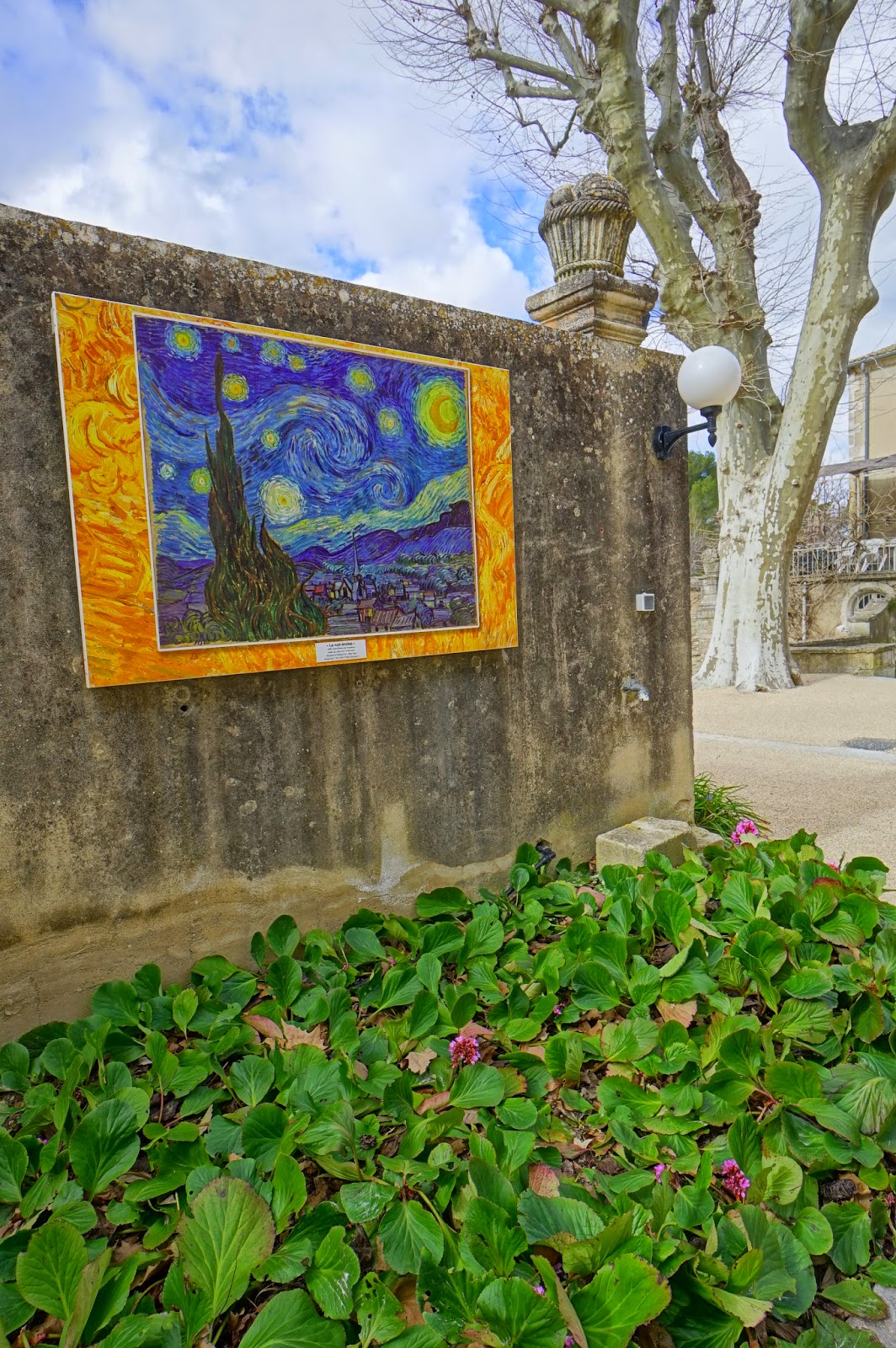
St. Remy: and my favorite! Van Gogh painted "Starry Night" during his stay at this hospital.

St. Remy: A replica of Van Gogh's room at the hospital, so faithful that the colors of the wall paint and the curtains are like he described in his letter to his sister.

St. Remy: The main hospital building with yet-to-bloom iris (left) and lavender (right) in the backyard, looked over by Van Gogh reproductions.

St. Remy: time for lunch in this compact city

St. Remy: after lunch, we just walk a few blocks to check out the birthplace of a famous son, Nostradamus


A short drive from St. Remy lies Les Baux, one of the most popular destinations in Provence and for a reason. It is a fascinating combination of rocks and ruins, and now a village of charming shops and restaurants. Thank God it is off-season and we don't have to rub elbows while walking up the narrow alleys.

Approaching Les Baux: which are castle ruins and which are the rocks? Any Bauxite sighting?

Les Baux: the castle ruins located at the top of the town is an fascinating place to walk around, except we faced howling winds.


Les Baux: the town below the castle ruins is chic and touristy.

Les Baux town

Les Baux: Crepes - the perfect remedy for the body beaten down by the cold wind

Leaving Les Baux at sunset


Wednesday is a market day in St. Remy but the winter lingers on and things don't get going until 9am. The Mistral, the notorious fierce north wind in Provence is in full force this morning and we brace ourselves for a 10 minute walk from our B&B to the center. We hurry back to our car to start the main agenda for today - a visit to Arles.

St. Remy: we are staying at this mas, a Provencal farmhouse.


St. Remy: market day at the City Hall plaza

Driving from St. Remy to Arles

Arles is bigger and also less gentrified than St. Remy. It has a real city feel with some of the dilapidation contributing to its charms. It's a minor market day here, too, sprawled about Place Lamartine. Near there, we locate the first of the Van Gogh "easels," comparing his paintings to those that served as models or inspirations, placed throughout the city. Yes, Vincent is also a big draw here - he loved Arles and produced some of his best known paintings here. But we also cannot ignore the Roman Arena, which is after all smack in the middle of the city as apparent on the aerial shot on postcards.

L'Arlesienne! Just wanted to say it, as Van Gogh painted it and Bizet composed it.


Arles: the "yellow house" is gone now, bombed during WWII, but the building behind it in the painting is still standing.

Arles: a street leading to the Roman Arena


Arles: Roman Arena, with its antiquity being partially masked by scaffolding

Arles: seen from the tower at the Arena
  
Even after a three-hour lunch, there is enough time to explore the major sites. Arles is fairly compact and walkable. Love this town!


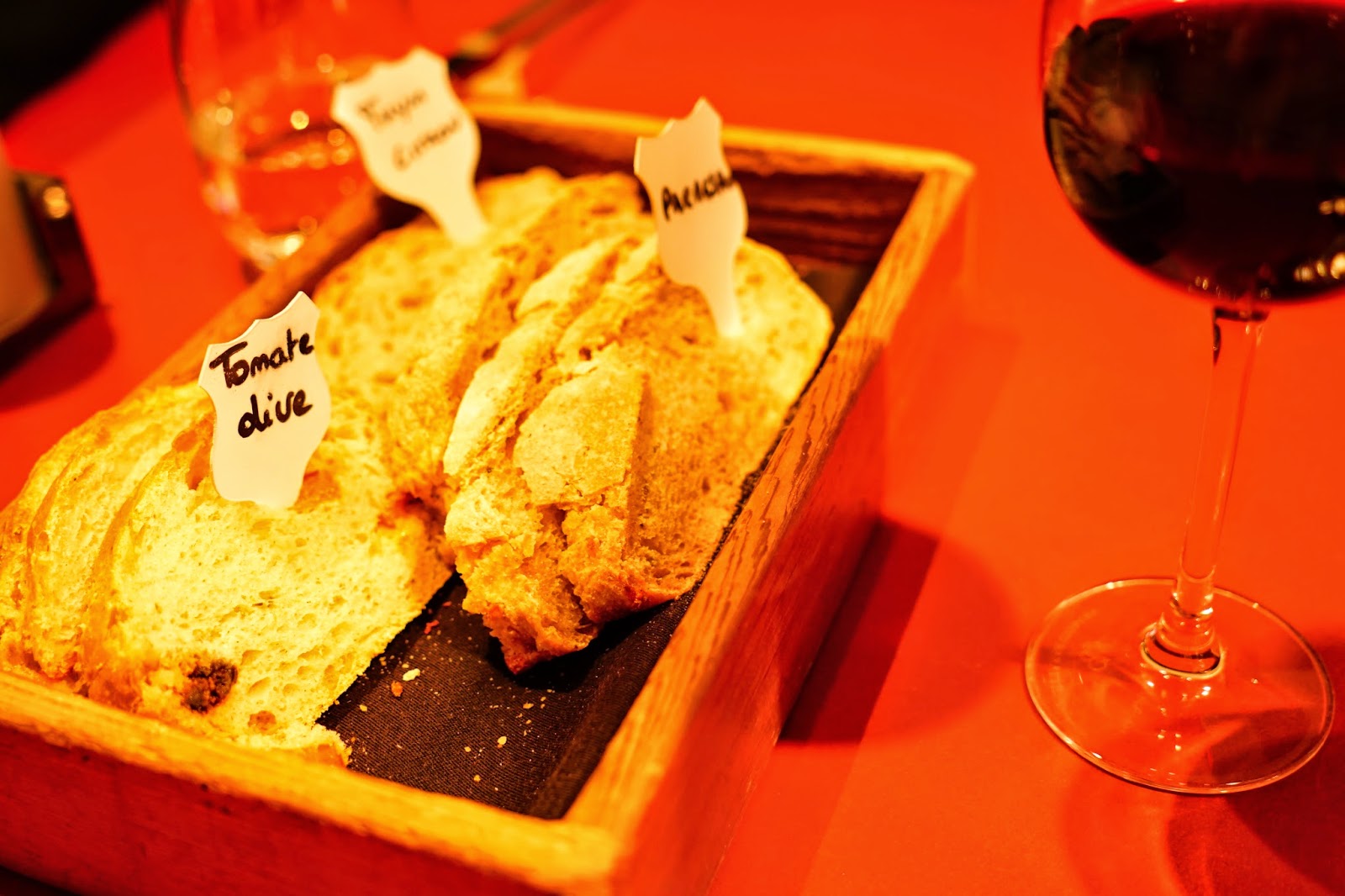
Arles: Labeled breads at L'Atelier de Rabanel


Arles: St. Trophim Church, which has served as a stop for pilgrims on Camino de Santiago, I was delighted to learn.

Arles: Forum Square. The old Roman forum site. The statue is Mistral, the Nobel prize winning Provencal poet. The yellow café (on right) was frequented by Van Gogh and the subject of his painting, Café la Nuit. It is now unabashedly named, yes you guess it, Café Van Gogh.

Arles: One last stop. Espace Van Gogh Cultural Center is the site of an old hospital where he stayed after he cut off his ear. Canny resemblance of his painting to the real courtyard that he loved to paint.